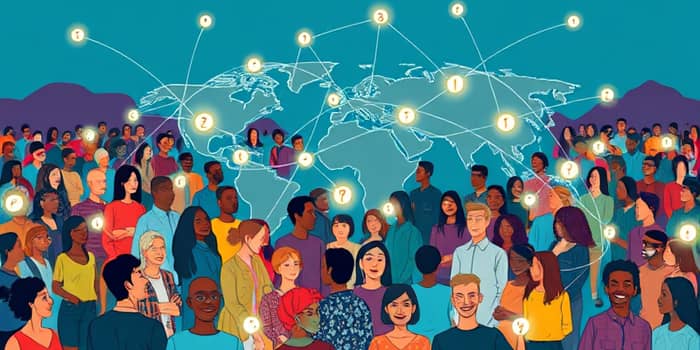
Decentralized Autonomous Organizations (DAOs) are more than a technological innovation—they are a paradigm shift that promises to reshape how people organize, collaborate, and govern shared resources. Emerging from the intersection of blockchain technology and collective governance, DAOs offer a bold alternative to traditional corporate structures.
By eliminating centralized leadership and embedding rules in self-executing smart contracts, DAOs enable transparent, automated decision-making. They equip communities worldwide with borderless participation and real-time collaboration, forging a model that is both resilient and inclusive.
The concept of a decentralized autonomous organization became tangible in 2016 with the launch of The DAO on the Ethereum blockchain. Although that first experiment faced security challenges, it illuminated the power of code-based governance.
Since then, the DAO ecosystem has exploded. By mid-2022, over 6,000 DAOs managed more than $25 billion in collective treasuries, spanning finance, media, politics, and beyond. This rapid growth reflects both technological maturity and an increasing desire for democratic control of resources.
Historically, organizations relied on hierarchical decision-making and opaque processes. DAOs upend that model, substituting trust in code for trust in people. Open-source smart contracts execute proposals automatically when predefined criteria are met, ensuring transparent enforcement of community decisions.
The mechanics of DAO governance can be broken down into four key stages. Each stage underscores the collaborative ethos and automated efficiency that define decentralized organizations.
Participants can delegate their vote if they are inactive, ensuring that decisions remain forward-moving even when some members step back. This combination of inclusivity and automation creates a robust framework for collective decision-making at scale.
When compared with traditional businesses, DAOs deliver distinctive benefits rooted in their decentralized nature. They harness the power of open-source code to provide transparency, reduce administrative overhead, and foster global collaboration.
By democratizing control and leveraging automation, DAOs reduce friction and accelerate innovation. Participants feel empowered, knowing their voice directly shapes outcomes.
Despite their promise, DAOs face practical and regulatory hurdles. Legal frameworks are often unclear, raising questions of liability and tax treatment. In some jurisdictions, DAOs lack recognized legal personhood, complicating contract enforcement.
Addressing these limitations requires collaborative efforts between technologists, policymakers, and legal experts. Emerging hybrid models, such as registered legal wrappers for DAOs, seek to marry code-based governance with recognized corporate structures.
DAOs are already disrupting diverse sectors. In decentralized finance (DeFi), protocols governed by DAO communities enable peer-to-peer lending, automated insurance pools, and decentralized exchanges that challenge traditional banks and brokers.
Media and content creation have also embraced the model. Creator DAOs empower artists to retain ownership, share revenue transparently, and involve fans in editorial decisions. Similarly, nonprofit and philanthropic DAOs channel micro-donations directly to vetted causes, enhancing trust and impact.
Political and civic applications are emerging. DAO-based platforms facilitate fund-raising for grassroots campaigns and coordinate volunteer efforts with verifiable voting systems, promising a new era of participatory democracy.
From venture funding to community-managed real estate, DAOs exemplify how distributed communities can mobilize resources in ways previously unimaginable under centralized regimes.
The trajectory of DAOs points to ever more sophisticated governance experiments. Layer-two solutions and cross-chain interoperability will scale networks, while on-chain reputation systems aim to mitigate plutocracy and boost engagement.
As legal clarity improves and tooling becomes more accessible, expect exponential growth in DAO adoption. Startups, nonprofits, and even established enterprises are exploring decentralized pilots, signaling a readiness to embrace transparent, automated organizational models.
Ultimately, DAOs offer a vision of business that is more equitable, efficient, and resilient. By aligning incentives through code, they invite participants to co-create value and share decision-making power. In this way, DAOs are not just the future of business—they are a blueprint for a more collaborative global economy.
References