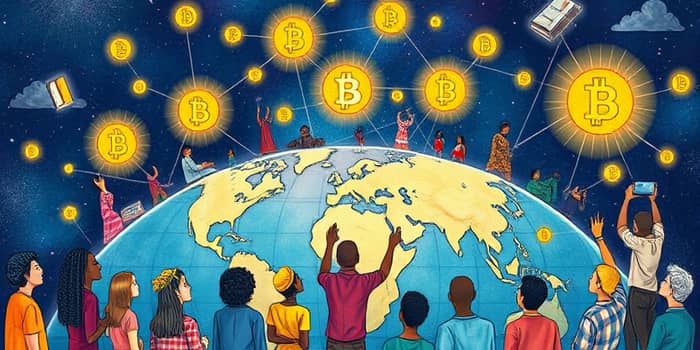
In a world where traditional banking systems often exclude millions and centralized intermediaries dictate access, decentralized finance is rewriting the narrative. By harnessing blockchain technology, DeFi empowers individuals to take control of their assets, participate in global markets, and unlock new opportunities—without waiting on permission from banks or regulators.
At its core, DeFi is a network of financial protocols and applications built on public blockchains, such as Ethereum. These protocols use automated execution via smart contracts to facilitate lending, borrowing, trading, and asset management directly between peers.
Unlike CeFi, where centralized authorities impose KYC, freeze accounts, and levy fees, DeFi provides open, transparent, permissionless access 24/7. Users retain custody of their funds using cryptographic keys, and every transaction is recorded on an immutable ledger for all to verify.
To illustrate the fundamental differences, consider this comparison:
The strength of DeFi lies in its modularity and composability. Protocols interoperate like "money Legos," allowing developers and users to build complex financial products.
The DeFi landscape has undergone explosive expansion, driven by institutional interest, retail adoption, and the rise of tokenized real-world assets (RWAs). Although metrics vary across research firms, all point to sustained growth over the next decade.
Mordor Intelligence projects the market to reach USD 238.54 billion by 2026, surging to USD 770.56 billion by 2031 at a 26.43% CAGR. Meanwhile, Grand View Research forecasts an even steeper climb from USD 37.27 billion in 2026 to over USD 1.4 trillion by 2033 (68.2% CAGR).
Geographically, North America commands the largest share—driven by compliance-friendly frameworks—while Asia-Pacific emerges as the fastest-growing region, fueled by forward-looking stablecoin and tokenization policies.
DeFi’s disruptive potential stems from its ability to deliver financial services that are:
Despite its promise, DeFi carries inherent risks that require vigilant management. Smart contract exploits, impermanent loss in liquidity pools, and lost private keys can result in irreversible losses. Regulatory clarity remains elusive in many jurisdictions, placing the onus on users to comply with evolving KYC and AML standards using specialized on-chain tools.
Scalability challenges on major blockchains have given rise to multi-chain solutions and layer 2 networks, reducing gas fees and congestion. Meanwhile, yield optimization platforms are refining strategies to balance returns with safety.
Emerging in 2026 is a surge in tokenized RWAs, forecasted to grow at a 39.72% CAGR to 2031, bringing corporate debt, real estate, and commodities on-chain with regulatory oversight. Institutional adoption accelerates through regulated DeFi wrappers and ETF approvals, fueling a more mature ecosystem.
For individuals eager to harness the power of DeFi, consider these steps:
By embracing programmable money and decentralized innovation, you can seize new financial opportunities while contributing to an open, inclusive global economy. The journey into DeFi is both a challenge and a liberation, offering unprecedented control and transparency. As the ecosystem evolves, informed participation will be the key to unlocking its full potential and forging a truly democratized financial future.
References