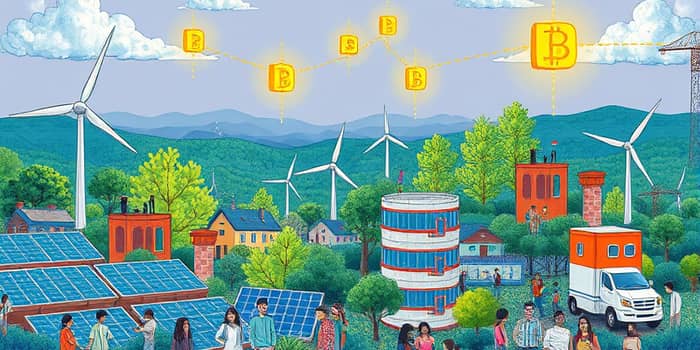
In a world facing environmental crises and social challenges, sustainable finance has emerged as a beacon of hope. As capital markets increasingly incorporate environmental, social, and governance (ESG) criteria into investment decisions, the fusion of blockchain technology is unlocking new possibilities. This article explores how these forces converge to reshape the financial landscape, offering practical guidance and inspiration for stakeholders ready to embrace this transformative journey.
By harnessing the power of digital ledgers and ESG frameworks, investors, companies, and regulators can align profit with purpose, ensuring that every dollar contributes to a healthier planet and more equitable society.
The sustainable finance market has experienced an unprecedented growth trajectory over recent years. In 2022 alone, global sustainable assets exceeded $4.2 trillion, and industry forecasts anticipate over $30 trillion by 2032. This shift reflects a broader realization that financial returns and social responsibility are not mutually exclusive.
Institutional investors, pension funds, and retail savers alike are seeking opportunities that deliver both competitive yields and measurable impact. Governments and standard-setting bodies have responded by integrating ESG disclosures into regulatory frameworks, further propelling market growth. As a result, sustainable finance is no longer a niche trend but a mainstream imperative.
Blockchain technology offers a tamper-proof and decentralized ledger that underpins the integrity of ESG data. By recording transactions in a transparent and immutable manner, blockchain mitigates risks such as greenwashing and data manipulation.
Key benefits include:
As companies strive to meet rigorous sustainability targets, blockchain ensures that reported metrics truly reflect on-the-ground performance, building confidence among investors and the public.
From supply chains to energy markets, blockchain is being deployed across multiple ESG use cases:
Each application leverages the core strengths of blockchain—security, traceability, and automation—to foster greater accountability and drive positive change.
Despite its promise, integrating blockchain into ESG ecosystems involves several hurdles:
Addressing these challenges demands collaboration among industry leaders, regulators, and technology providers. By adopting best practices in governance, security, and stakeholder engagement, organizations can navigate the complexity and realize blockchain’s full potential in sustainable finance.
To turn vision into reality, stakeholders must follow a clear, actionable roadmap. The table below outlines critical steps for investors, companies, and regulators, paired with the benefits they unlock.
This collaborative approach ensures that each participant contributes to a robust, trustworthy ecosystem where capital allocation and sustainability goals advance hand in hand.
As we peer into the next decade, the convergence of ESG principles and blockchain technology promises to revolutionize how capital flows into sustainable projects. Decentralized finance (DeFi) platforms are emerging, offering individuals direct access to green investment opportunities once reserved for large institutions.
Innovations such as tokenized real assets, peer-to-peer carbon credit exchanges, and programmable impact bonds will continue to accelerate global sustainability goals. By adopting these tools, stakeholders can democratize access to sustainable investment, ensuring that every participant—regardless of scale—can contribute meaningfully to the UN Sustainable Development Goals.
Ultimately, the fusion of blockchain and ESG is more than a technological trend; it is a catalyst for systemic change. Together, we can harness this synergy to build a financial system that prioritizes long-term prosperity, environmental stewardship, and social equity. The path is clear: embrace innovation, champion transparency, and commit to a shared vision of a sustainable future.
References