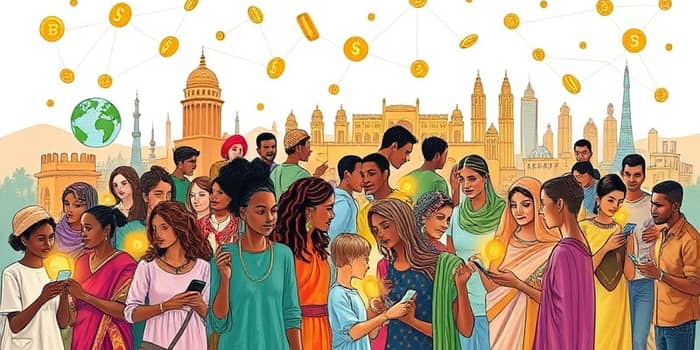
In a world where digital finance is rapidly advancing, 1.7 billion adults remain excluded from basic financial services.
This staggering number represents individuals who lack access to savings, credit, and payments due to high costs, remote locations, or lack of documentation.
Blockchain technology emerges as a beacon of hope, offering decentralized, low-cost, borderless financial tools that can transform lives and communities.
By bypassing traditional banking barriers, it promises to democratize finance and uplift the underserved.
Financial exclusion perpetuates poverty and limits economic growth on a global scale.
Women and rural populations face particular barriers, often struggling to participate in the formal economy.
Innovations like mobile money have shown potential, but gaps remain that blockchain can fill effectively.
For example, in Kenya, M-Pesa lifted 194,000 households above the poverty line and enabled 185,000 women to change occupations.
This demonstrates the power of accessible financial tools in driving real change.
Blockchain addresses these issues by providing solutions that are inclusive and scalable.
At its core, blockchain enables secure, transparent transactions without intermediaries.
This technology empowers the unbanked through various mechanisms that are simple and accessible.
These tools collectively create a financial ecosystem that is open to everyone.
By leveraging smartphones, even basic devices, blockchain brings banking to the palm of your hand.
Across the globe, blockchain projects are making a tangible impact on financial inclusion.
From Cambodia to Argentina, innovative solutions are empowering communities and fostering economic growth.
These examples highlight how blockchain is not just a theoretical concept but a practical tool for change.
They show that with the right technology, financial barriers can be overcome.
Looking ahead to 2026, blockchain and crypto are set to expand their reach significantly.
The growth projections indicate a shift towards broader adoption and institutional involvement.
This trend towards mainstream acceptance means more opportunities for the unbanked to participate.
It signals a future where financial tools are universally accessible and empowering.
Despite the promise, blockchain faces hurdles that must be addressed for sustainable impact.
Volatility, regulatory uncertainty, and environmental concerns are key risks that need mitigation.
Additionally, there are numerous use cases that can further drive inclusion.
By tackling these challenges and leveraging opportunities, blockchain can create a more equitable financial world.
It calls for collaboration between developers, governments, and communities to build inclusive systems.
Blockchain technology holds the key to unlocking financial inclusion for billions worldwide.
Through innovative tools and real-world applications, it is already making a difference.
The journey ahead requires perseverance and collective effort to overcome obstacles.
By embracing this technology, we can ensure that no one is left behind in the digital economy.
Let's work together to build a world where financial empowerment is a reality for all.
References