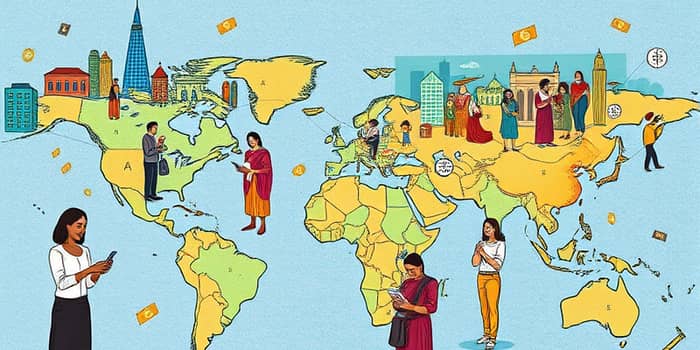
Across continents and cultures, the promise of financial access has become a beacon of hope for billions. Yet, while strides have been made, significant barriers stand between underserved communities and the tools they need to thrive.
Innovations in technology now offer an unprecedented opportunity to close these divides and foster economic resilience on a global scale.
Over the past decade, account ownership has surged from 62% to 79% among adults worldwide. In low- and middle-income countries, a 20-point rise to 75% demonstrates how digital channels can unlock financial access for remote communities.
Nevertheless, regional disparities persist: East Asia and the Pacific lead at 83%, while the Middle East and North Africa remain at 53%. And even with these gains, 1.6 billion people still excluded reminds us that the journey is far from over.
The fintech landscape now comprises nearly 30,000 startups that span digital lending, payments, banking, insurtech, and wealthtech. In the first half of 2025 alone, global funding hit $44.7 billion, fueling a wave of creative solutions aimed at those traditionally overlooked by banks.
Notably, services targeting micro, small, and medium enterprises (MSMEs) grew from 48% to 58% of offerings in just one year. Fintech innovators are also developing innovative credit scoring models that leverage mobile usage, utility payments, and social data to underwrite loans for new borrowers.
Digital payments have become a cornerstone of inclusion. Today, 62% of adults globally make or receive payments electronically, up 28% over the last decade.
Mobile money services have empowered market vendors in Sub-Saharan Africa, while QR code and contactless options have revolutionized small purchases in South Asia. These platforms not only ease transactions but also provide a foundation for savings and credit history.
The rise of Buy Now, Pay Later (BNPL) has redefined credit for consumers, reaching $350 billion in transaction value in 2024. Peer-to-peer and marketplace lending added $62 billion more, democratizing access to capital.
In regions like Sub-Saharan Africa, fintech lending to small enterprises skyrocketed from 13% to 88% of investment focus between 2020 and 2023, driving entrepreneurship and job creation. By embracing alternative data, lenders can serve rural borrowers without formal credit records.
Formal savings have also surged: 40% of adults in low- and middle-income economies now hold savings accounts, a 16-point leap since 2021. Mobile wallets have enabled remote communities to build safety nets, reducing vulnerability to shocks.
Yet nearly half of people in developing countries could not cover one month’s expenses during an emergency, underscoring the need for continued innovation in savings products and community-based insurance schemes.
Women’s account ownership in low- and middle-income countries rose to 73%, narrowing the gender gap to 5%. Several nations in South Asia and the Pacific have achieved parity, illustrating how targeted outreach and simplified onboarding can empower women economically.
However, women’s deposit balances average only 64% of men’s, and loan access is at 46%. Addressing these disparities requires customized products, financial education, and partnerships with women’s organizations.
Despite rapid growth, critical challenges remain:
These barriers leave individuals vulnerable to fraud, over-indebtedness, and predatory schemes. Solutions must balance innovation with consumer protection and robust data security.
The focus of financial inclusion is shifting from product access to meaningful outcomes. Organizations now emphasize financial health as the goal, integrating resilience, equity, and well-being into their metrics.
This align with broader development goals has sparked collaborations across climate, health, and digital public infrastructure, creating ecosystems where financial services reinforce other social objectives.
Real change requires collective action:
Fintech stands at a pivotal crossroads. By prioritizing inclusive design, consumer protection, and strategic partnerships, we can ensure that every person—whether a market vendor in Nairobi or a farmer in Bihar—can participate fully in the global economy.
With a shared vision and collaborative effort, the next wave of innovation can bridge the gap and turn financial inclusion from aspiration into reality.
References