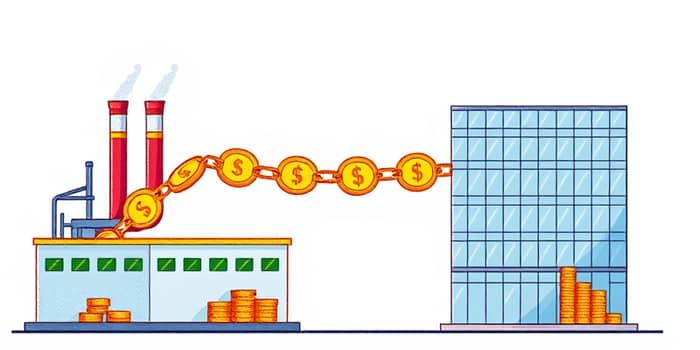
In an era of economic uncertainty, managing cash flow effectively can mean the difference between business survival and failure. Supply Chain Finance (SCF) offers a transformative solution that bridges gaps in financial stability.
This innovative approach allows suppliers to receive early payments on approved invoices. It leverages the buyer's strong credit rating to provide cost-effective financing options for all involved parties.
By optimizing working capital, SCF enhances operational efficiency and fosters stronger business relationships. It ensures that cash flow constraints are alleviated without disrupting the supply chain's harmony.
Supply Chain Finance, often called reverse factoring, is a strategic financial tool. It enables suppliers to get paid early by a third-party financier based on the buyer's creditworthiness.
Buyers can extend their payment terms, improving their own liquidity. This process creates a balanced financial ecosystem where both parties benefit significantly from enhanced cash flow management.
Unlike traditional loans, SCF involves selling receivables to access funds quickly. This mechanism reduces the need for collateral and simplifies financial operations.
SCF provides a multitude of advantages for both suppliers and buyers. These benefits drive growth and stability in volatile markets.
For suppliers, the advantages are clear and impactful.
Buyers gain equally substantial rewards from implementing SCF.
The SCF process is straightforward and relies on collaboration between buyers, suppliers, and financiers. Automation through technology platforms streamlines operations.
Here is a step-by-step breakdown of how it typically functions.
This cycle ensures that cash flow is optimized efficiently without burdening any single party. Technology plays a crucial role in reducing errors and scaling solutions.
Across various industries, SCF has demonstrated measurable success in enhancing business performance. The following table highlights key examples from real companies.
These case studies show that SCF drives tangible financial improvements and operational efficiencies. They highlight its versatility across different sectors and challenges.
While SCF offers many benefits, it is not without its obstacles. Understanding these can help businesses navigate implementation more effectively.
Common challenges include dependency on buyer credit for suppliers. Buyers may face initial receptivity issues from vendors during rollout.
Strategies to mitigate these risks involve pilot programs and phased rollouts. Benchmarking KPIs ensures that performance metrics are aligned with business goals.
Technology is the backbone of modern SCF, enabling scalability and security. Platforms like PrimeRevenue connect thousands of suppliers and buyers globally.
Automation reduces human error and speeds up transaction processing. It also enhances data security and compliance with financial regulations.
By leveraging technology, businesses can achieve greater efficiency and cost savings. This makes SCF more accessible and effective for diverse organizations.
The future of SCF looks promising, with growing adoption in response to market volatility. Trends indicate a shift towards more sustainable and global solutions.
Businesses are increasingly using SCF to fund inventory amid high capital costs. This trend is driven by the need for resilient financial strategies in uncertain times.
SCF is evolving beyond a mere financial tool into a strategic enabler. It empowers businesses to thrive in complex and dynamic economic landscapes.
Adopting SCF requires careful planning and execution. Here are some actionable steps to get started and maximize benefits.
Begin by assessing your current cash flow and supply chain needs. Engage with key stakeholders, including suppliers and financiers, to build consensus.
By following these tips, businesses can unlock the full potential of SCF and drive long-term success. It's a journey towards financial optimization and stronger partnerships.
Embrace SCF as a catalyst for growth and resilience in today's competitive market. It transforms cash flow management from a challenge into an opportunity for innovation.
References