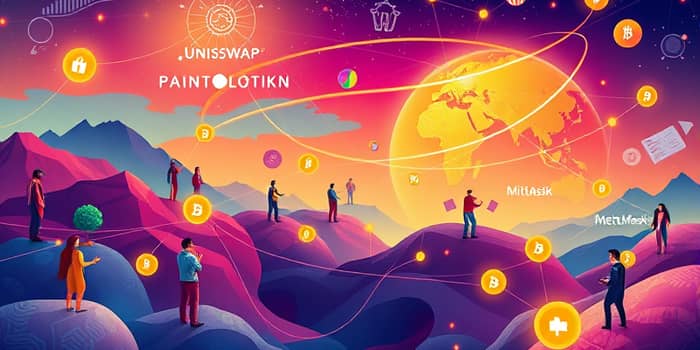
In a world where traditional finance often feels slow and exclusive, a seismic shift is underway, powered by blockchain technology and a vision for greater accessibility.
Decentralized Finance, or DeFi, is redefining how we interact with money, eliminating intermediaries and fostering transparency in ways never seen before.
This revolution promises to democratize financial services, offering everything from lending to trading on a global scale.
Imagine a financial ecosystem where anyone with an internet connection can participate, free from the constraints of banks and brokers.
As we delve into this transformative journey, we'll explore the growth, challenges, and incredible potential of DeFi to reshape our economic landscape.
The roots of DeFi trace back to the early days of blockchain, but it truly gained momentum around 2020.
Total Value Locked, a key metric, soared from USD 9.1 billion in July 2020 to peaks exceeding USD 177 billion in early 2022.
Despite a subsequent decline, current TVL stands at around USD 52 billion, showcasing resilience and a 5x growth from its 2020 baseline.
This volatility reflects the nascent nature of the sector, yet underscores its capacity for rapid expansion.
Key milestones, such as JPMorgan's first cross-border DeFi transaction in 2022, highlight growing institutional interest.
The market cap surged from USD 27.7 million in September 2020 to a peak of over USD 3 billion in July 2021.
As we move into 2024-2025, recovery signs are evident, with momentum building for a new era of innovation.
At its core, DeFi relies on smart contracts and blockchain networks to automate financial transactions securely.
Ethereum remains the dominant ecosystem, holding over 58% of DeFi liquidity and setting the standard for decentralized applications.
Wallets like MetaMask, with 30 million users and 3,800% growth since 2020, provide essential gateways for user interaction.
Decentralized exchanges, such as Uniswap with a weekly volume of USD 11.63 billion, enable seamless trading without intermediaries.
These technologies ensure that DeFi operates on principles of decentralization, transparency, and accessibility.
The DeFi market is poised for explosive growth, with projections ranging from USD 616.1 billion to over USD 2 trillion by 2035.
Compound Annual Growth Rates vary from 27% to 68.2%, reflecting diverse analyst methodologies but a consistent upward trend.
This growth is fueled by increasing adoption, technological innovation, and a push for financial inclusion globally.
Below is a table summarizing key market projections from various sources, highlighting the optimistic outlook for DeFi.
These figures underscore the immense potential of DeFi to scale and integrate into mainstream finance.
Drivers include secure blockchain transactions and the rise of yield farming, which attract users seeking higher returns.
North America leads with over 36% global share, driven by key players like Compound Labs and Uniswap.
This dominance is supported by robust crypto infrastructure and regulatory frameworks that encourage innovation.
Asia Pacific, however, is the fastest-growing region, expected to achieve the highest CAGR due to economic expansion and tech adoption.
Countries like Vietnam and Thailand show high DeFi adoption indexes, reflecting grassroots enthusiasm for decentralized solutions.
Europe and Latin America also contribute significantly, with nations like Germany and Brazil embracing fintech advancements.
DeFi applications span lending, trading, and beyond, offering alternatives to traditional banking.
Lending platforms like Aave and Maple Finance enable users to borrow and lend assets directly, bypassing banks and reducing costs.
Trading on DEXs such as Uniswap and Hyperliquid provides liquidity and efficiency rivaling centralized exchanges.
Stablecoins and tokenized assets are gaining traction, offering stability and new investment opportunities in volatile markets.
Yield farming allows users to earn rewards by providing liquidity, incentivizing participation and growth.
Despite its promise, DeFi faces significant hurdles, including security exploits and market fluctuations.
Major hacks, like the Ronin bridge incident in 2022, resulted in losses exceeding USD 600 million, highlighting vulnerabilities.
TVL volatility, with a 76% drop from peak levels, underscores the market's susceptibility to crypto cycles and external shocks.
Regulatory uncertainty in many regions poses challenges for widespread adoption and integration with traditional finance.
However, these obstacles are driving improvements in security protocols and risk management strategies.
Looking ahead, DeFi is set to enter an institutional era, with Exchange-Traded Products and stablecoins leading the charge by 2026.
Projections suggest the market could reach trillion-scale by 2033, fueled by increased institutional participation and tech advancements.
Comparisons with traditional finance reveal DeFi's advantages in speed, cost, and inclusivity, positioning it for mainstream acceptance.
As blockchain technology matures, expect deeper integration into sectors like banking and insurance, driving global financial transformation.
The journey from niche innovation to global powerhouse is underway, inviting everyone to be part of this financial renaissance.
References