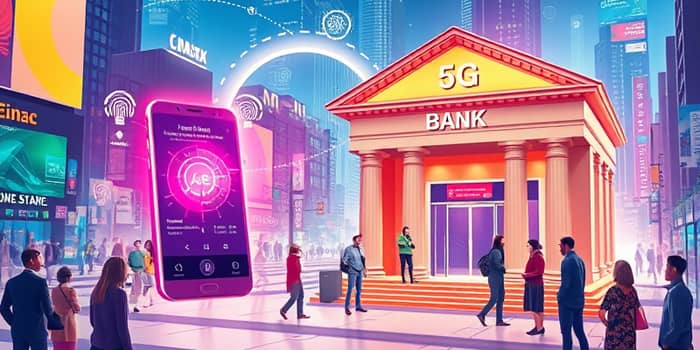
In today’s rapidly evolving digital landscape, the arrival of 5G networks is more than just a speed upgrade—it is a catalyst for sweeping transformation in the financial sector. From banking apps to branch operations, the shift promises enhanced speed, low latency, and massive connectivity that will redefine how institutions and customers engage.
As providers roll out nationwide coverage, financial services stand on the brink of a new era. With projections of over 2.6 billion global connections by 2025 and operator revenues surpassing $600 billion by 2026, the scale of change is staggering. But beyond numbers, the true impact lies in the experiences and opportunities that 5G unlocks.
One of the most visible shifts will be in how customers interact with their finances. Banking apps, websites, and IoT-enabled platforms will leverage hyper-personalized interactions across devices—from smartphones and wearables to vehicles and home assistants. Real-time data analytics, powered by low-latency networks, will allow institutions to tailor offers and advice to each user’s behavior.
Imagine an app that monitors spending patterns and instantly prompts a personalized savings plan, or wearable devices that alert you to unusual transactions as they happen. With 5G, these scenarios move from concept to reality, creating an omni-channel ecosystem where every touchpoint is seamlessly connected.
High-speed data transfer underpins advanced artificial intelligence and machine learning applications in finance. Real-time lending decisions, fraud analytics, and predictive product recommendations will become the norm rather than the exception. By offloading heavy computations to cloud servers at the edge, banks can deploy ultra-responsive digital assistants and advisers without burdening customer devices.
Credit approvals that once took days can be completed in minutes, while chatbots equipped with natural language understanding offer contextual guidance across channels. This shift also facilitates continuous deployment of security patches and feature updates, ensuring that services remain cutting-edge and resilient.
Even as digital channels expand, physical branches will be reimagined for the 5G era. Smart branches equipped with video analytics, virtual reality interfaces, and advanced biometrics will deliver immersive, secure client experiences at scale. Facial recognition and behavioral analytics can streamline identification, while VR consultations allow complex financial planning in a fully interactive environment.
Leading banks, such as the Bank of China and China Construction Bank, are already piloting 5G-enabled equipment connectivity to monitor assets and tailor in-branch journeys. The result is a seamless blend of digital agility and human touch, ensuring that branches remain relevant and value-driven.
5G’s expansive reach and real-time translation capabilities hold particular promise for underserved communities. Pop-up or mobile branches can deploy VR-based digital banking in remote regions, overcoming infrastructure constraints. Multilingual support powered by instant language translation bridges cultural and linguistic gaps, fostering inclusive access to modern financial tools.
As mobile coverage extends and devices become more affordable, rural populations gain access to microloans, savings plans, and insurance products in real time. Governments and NGOs can leverage this connectivity to accelerate economic development and reduce inequalities.
With faster networks come more sophisticated threats—and more powerful defenses. Real-time fraud detection engines analyze multidimensional biometric data, network patterns, and geolocation signals to spot anomalies in milliseconds. Tokenization, encrypted channels, and continuous monitoring will drive a robust, proactive security posture across services.
Consumers benefit from seamless updates and patch deployments, ensuring that endpoints remain protected without service interruption. Early adopters report fraud losses reduced by over 26% in card-not-present scenarios, underscoring the potential of 5G-enabled security frameworks.
The combination of low latency and massive device density is accelerating mobile payment adoption. Peer-to-peer transfers, proximity payments, and e-commerce checkouts all benefit from near-instant settlement. Integration with instant settlement rails—such as FedNow and RTP in the U.S.—further cements the promise of real-time, frictionless financial exchanges.
Consider the U.S. mobile payments market, projected to reach $519 billion in 2026, or the global market soaring past $6.46 trillion. Transaction volumes on RTP networks topped 343 million payments worth $246 billion in 2024. Apps like Venmo, Cash App, and Zelle now handle tens of billions of dollars monthly, reflecting consumers’ appetite for immediacy.
Beyond direct service benefits, 5G contributes significantly to economic growth. Analysts forecast net gains of $55 billion to global GDP by 2030 through improved customer experiences, and another $30 billion from reduced fraud losses. Edge computing investments of $40 billion by 2026 highlight the scale of infrastructure shifts underway.
As mobile payments expand, banks, fintechs, and network operators all benefit from new revenue streams and engagement models. This virtuous cycle drives further investment in 5G, edge computing, and digital services.
While the benefits of 5G in finance are profound, challenges remain. Infrastructure costs, regulatory hurdles, and potential cybersecurity gaps require coordinated industry efforts. Banks must modernize legacy systems and invest in workforce skills to fully leverage edge computing and AI.
Yet the vision of “invisible banking”—where financial services blend seamlessly into daily life—drives innovation forward. From VR branches to autonomous financial agents, 5G stands as the backbone for an era defined by seamless, intuitive financial experiences that empower individuals and institutions alike.
As networks expand and standards mature, the true measure of success will be the extent to which every user, regardless of location or background, can access fast, secure, and personalized financial services. In this unfolding narrative, 5G is not just a technology—it is the bridge to a more inclusive and dynamic financial future.
References